The Dawn of Everything
After more than a year of dipping in and out of this book, I finally got around to finishing Graeber and Wengrow's The Dawn of Everything, thanks to all the doctor's appointments and other opportunities for waiting around that come with being a foster parent. Not to mention throwing my smartphone into a lake (metaphorically).
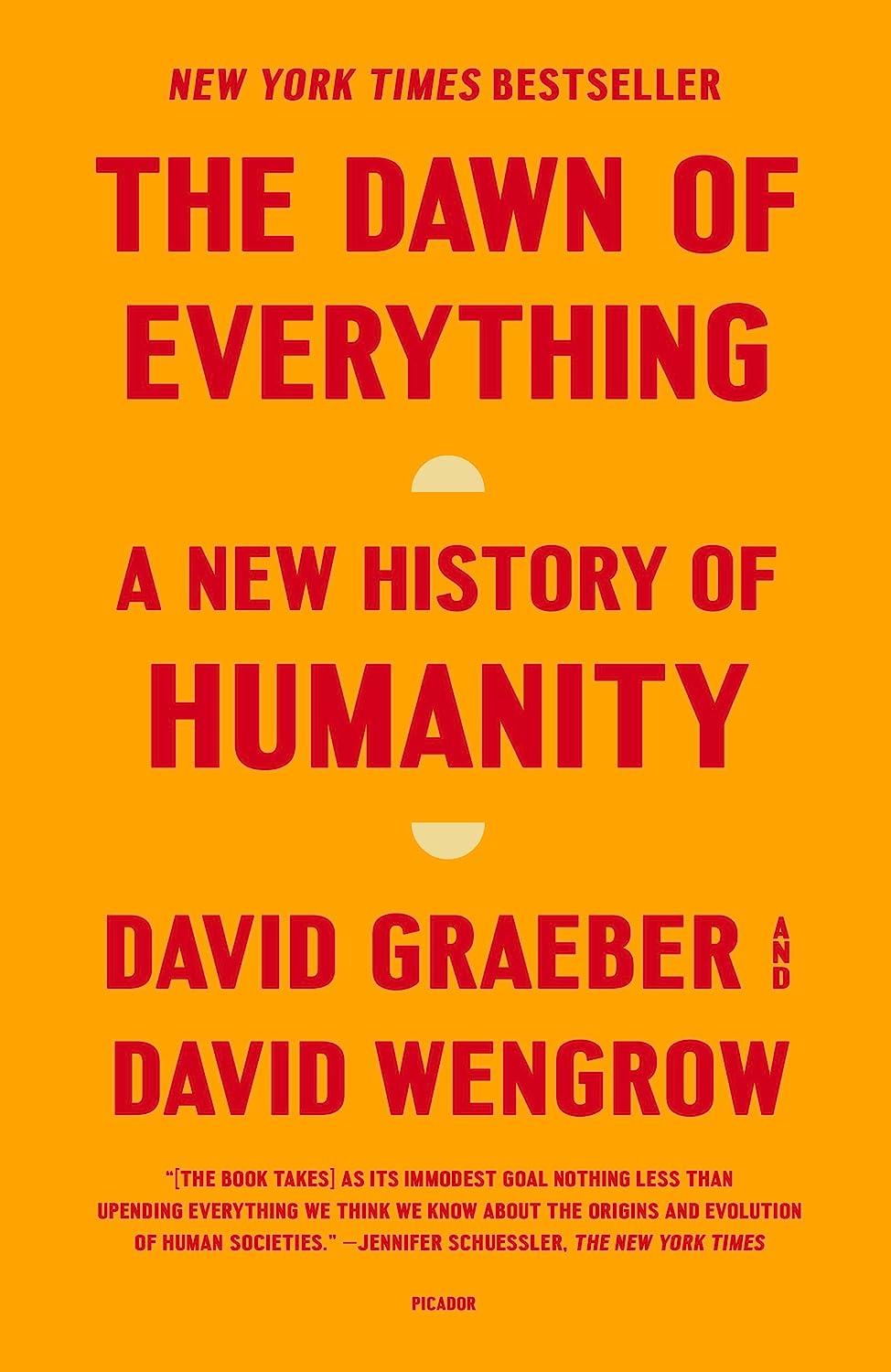
I mostly read this for fun rather than in an academic sense and avoided the 150+ pages of footnotes. My main takeaway is simply that it was fun to learn about all sorts of different societies and their methods of organizing themselves—which is aided by the fact that part of the book's thesis is that prehistoric societies were much more diverse than the traditional story of "societies were simple, egalitarian hunter-gatherers until government was invented."
Graeber and Wengrow argue that the current hierarchical system is not an inevitable final step in social evolution. Human societies have taken many different forms, and large societies have existed without some of the centralized authority, bureaucracy, and permanent hierarchy that we tend to assume are necessary. Graeber and Wengrow don't really answer why society ended up like it is now despite alternatives being possible. I would theorize that while societies with unequal power structures are often bad at being nice places to live, they can be good at being powerful and militaristic and may therefore tend to conquer or otherwise absorb more egalitarian societies.
By that theory, it does kind of seem like the current state of things is inevitable after all. Surely inequality isn't essential for a society to run itself well, but if a more egalitarian society can't resist its power-hungry neighbors, then it may eventually come to an end. Perhaps history isn't completely inevitable, but it does have a certain gravity.
The remaining question is whether we can become unstuck from this current social order. Luckily, Workers' Councils gives me some hope that the answer is yes.
My next read is going to be The Naked Anabaptist: The Bare Essentials of a Radical Faith, as I have been enjoying my newfound Mennonite community in a (surely surprising to those who know me) return to faith. I will, for now, resist the urge to go into how Christianity is (or ought to be) a radically leftist faith, but you'll hear it soon enough.