Worker's Councils
I started Workers Councils by Anton Pannekoek with my local IWW bookclub, but in my typical fashion, I fell behind after the first couple meetings. Exacerbated by the fact that my dog ripped the book half to shreds, I put it down for a while. Last week I picked it back up and finally finished it. Most of the book was legible, luckily, save for a few pages in the back.
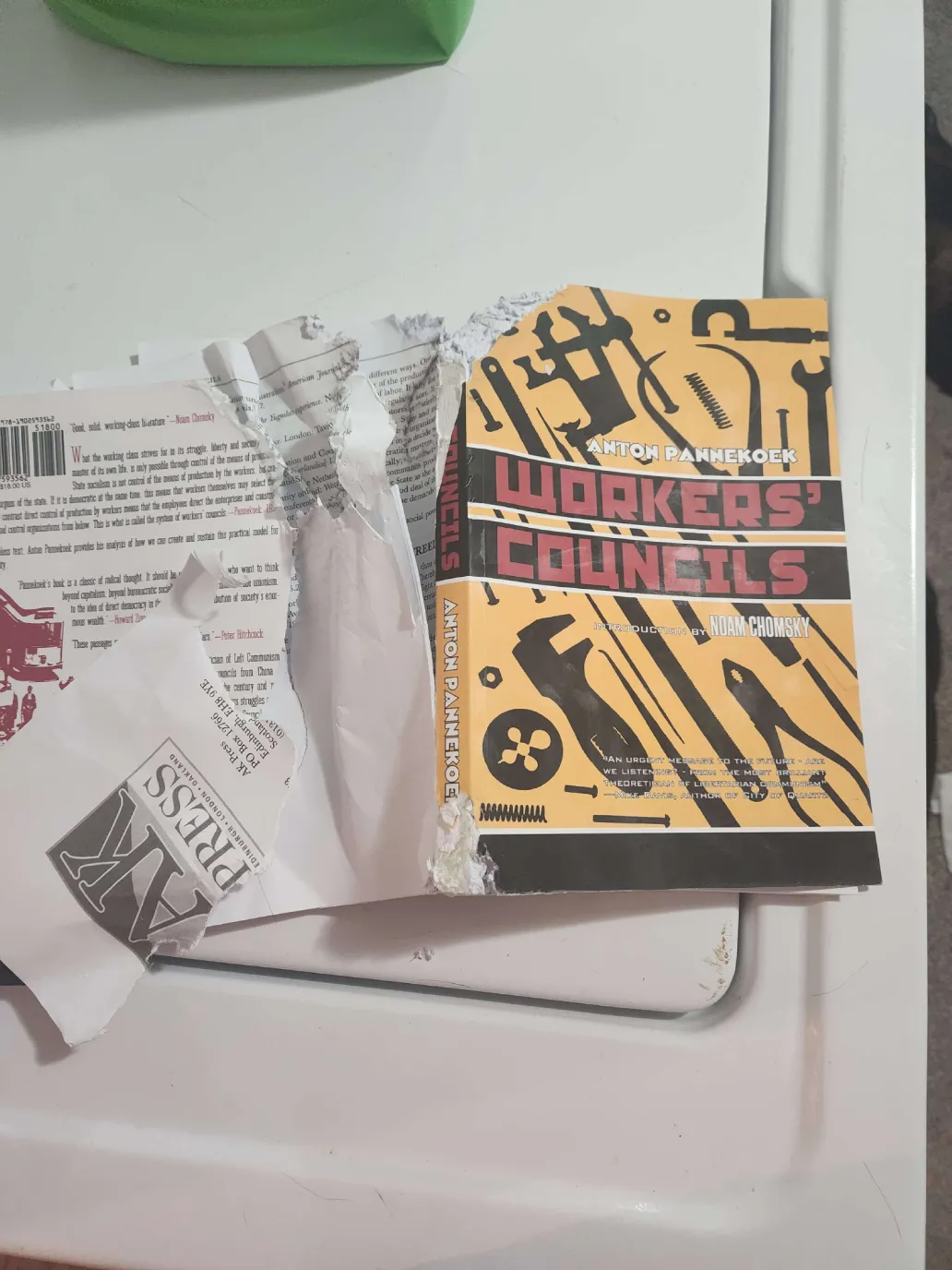
The book itself is a bit dense but it offers a pretty comprehensive framework of how society aught to be organized. The central concept is, of course, workers councils. These are to be formed by unions. Not the big unionization-as-a-service business unions which often just act as another middleman between the workers and the boss, but a true solidarity union that is made up by and for the workers. When the union become powerful enough, they can make demands for better conditions, better pay, more say in the production process, etc.. Eventually, the boss might give in and sell the company to the workers—at this point, the workers can own the workplace cooperatively and adaminister it thorgh a council.
Workers Councils provides a good example of dual power in action. Dual power is the leftist theory in which the revolution is not a single takeover of the government by the people but where people create alternate, democratic systems of organization that do not rely on state power, while still existing along-side it. The idea is that as these alternate systems grow in power, they will become preferable to the state-controlled system and essentially make the goverment/capitalist system obsolete.
A major type of system in a dual power world is the workers council, in which worker control over the means of production replaces the traditional capitalist model. But areas like housing, food, and security can all be democratized as well through organizations like tenant unions, food distribution groups (such as Food Not Bombs), and commmunity defense organizations.
Workers Councils also explains how these various councils coordinate with each other through delegates. Delegates are not the same as representatives—representatives are expected to use their own judgement, even if it means going against the opinion of their constituents. Delegates, however, are sent out with a specific task and instructions decided democratically by the council-of which any worker can be a member. Unlike our current top-down approach to governance, this power strucuture will be organized from the bottom up as councils network with each other through delegates, with authority always comming from the workers.
If you have a hard time understanding how a different way of organizing the world is possable, this is a good book along the lines of Kropotkin's The Conquest of Bread for getting an overall picture. Or, if you want to be better than me, sitting on my ass reading theory, you can get out there and organize your workplace, unionize your apartment bulding, or start a community garden.
Meanwhile, I'll be slowly working my way through The Dawn of Everything until I get a copy of ivan Turgenev's A Sportsman's Sketches.